Take Me Back To Dear Old Blighty
 |
 |
 |
.jpg) |
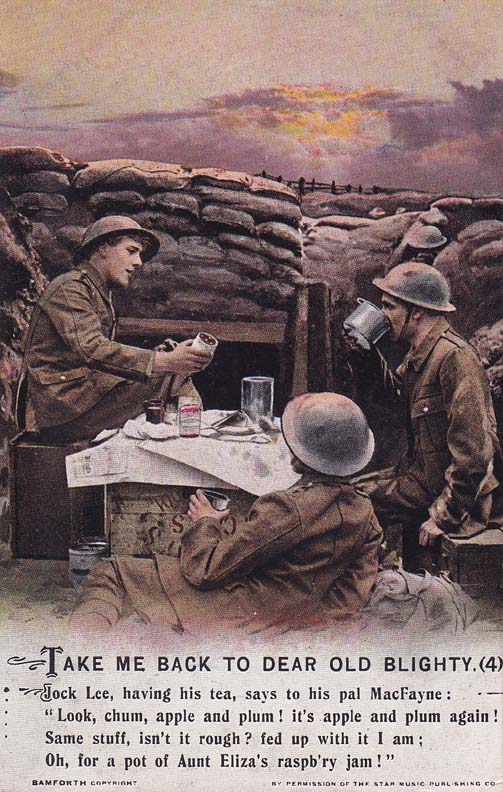
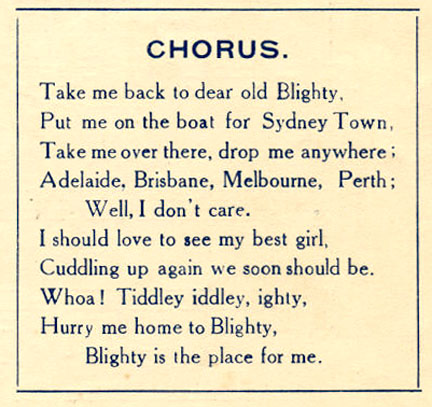
The lyrics of this Australian edition substitute local names for the English cities in the original (see below). |
 |
 |
 |
|
Author’s collection. |
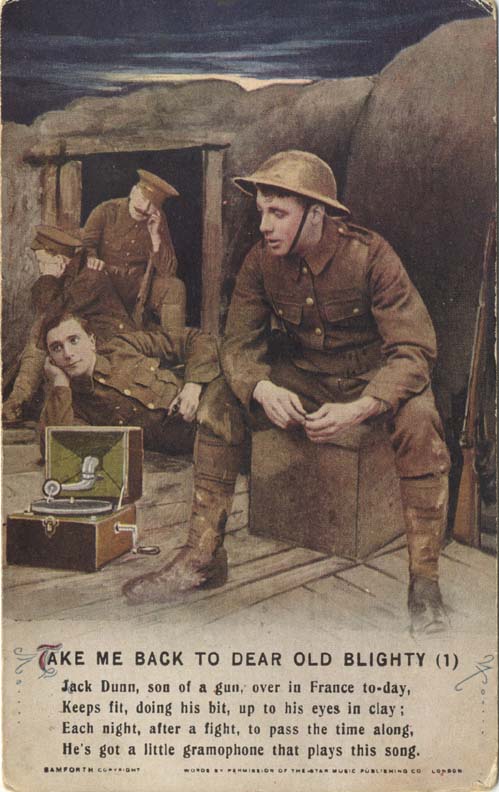
Author’s collection. |
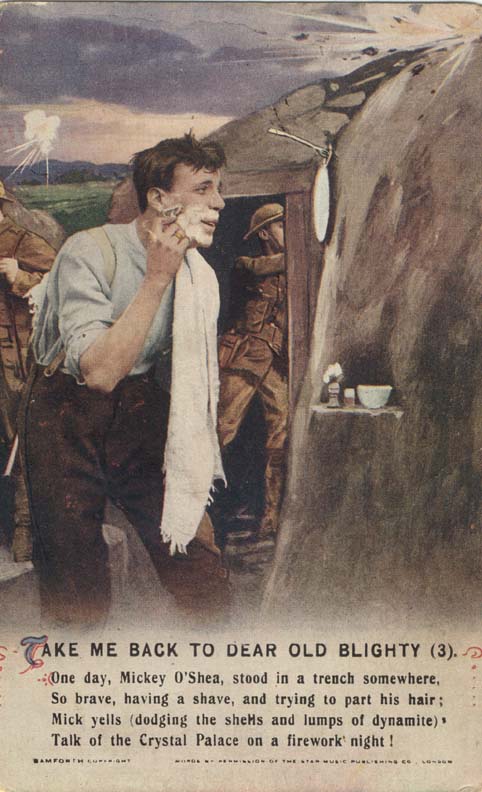
Author’s collection. |
Image courtesy of
Gart T. Westerhout, http://osugimusicaltheatre.com |
|
|||
 |
.jpg) |
 |
|
Author’s collection. |
Take Me Back To Dear Old Blighty / 19820400-005 / George Metcalf Archival Collection /© Canadian War Museum |
Author’s collection. |
Author’s collection.
|

 |
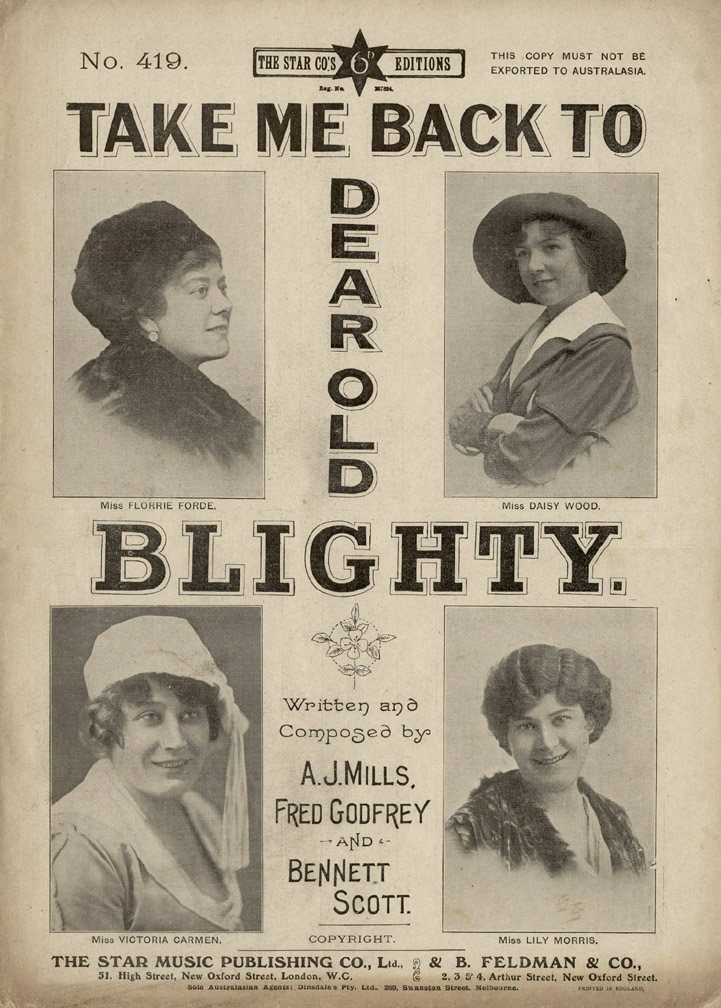
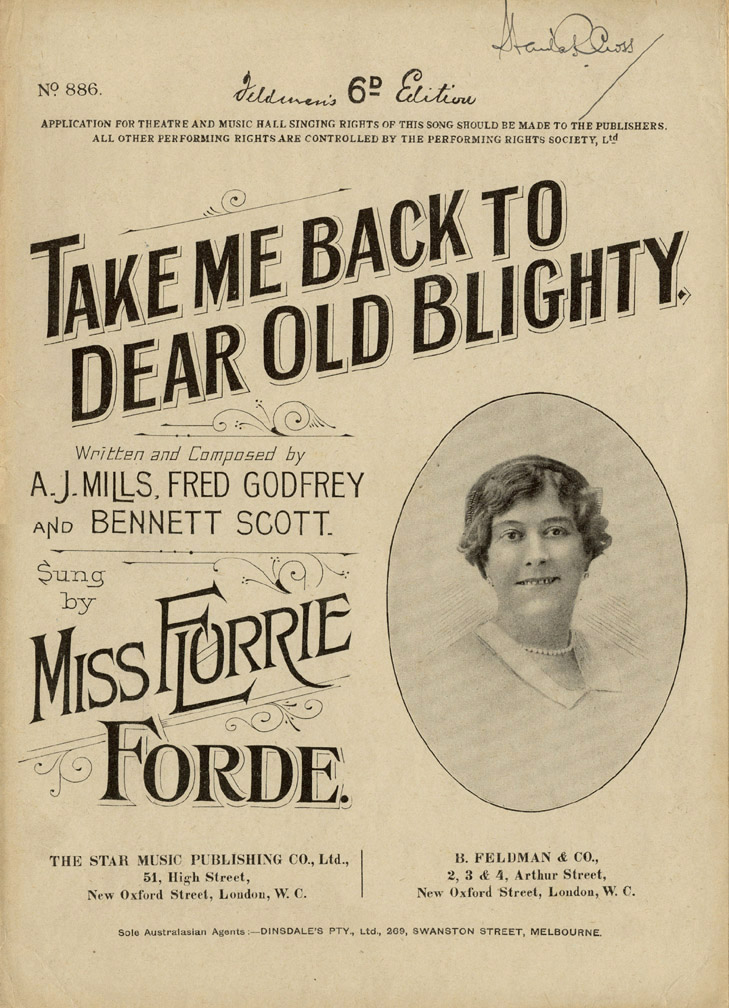
A.J. Mills, Fred Godfrey & Bennett Scott — London: Bert Feldman, Star Music; New York; Toronto: Chappell; Melbourne: Dinsdales’, 1916.
Note: Society of Composers, Authors and Music Publishers of Canada (SOCAN) apportions royalty shares under song title “Take Me Back To Blighty” as follows: Godfrey (16.667%), A.J. Mills (16.666%), Bennett Scott (16.667%), Chappell Music (25.0%), Glenwood Music (25.0%); under song title “Take Me Back To Dear Old Blighty” as follows: Godfrey (16.667%), A.J. Mills (16.666%), Bennett Scott (16.667%), Warner Chappell Music Canada (25.0%), PRS [Performing Right Society]Shares (25.0%)
* * * * * * * * * * * *
 |
Listen
to a 1916 recording by Florrie Forde. MP3 |
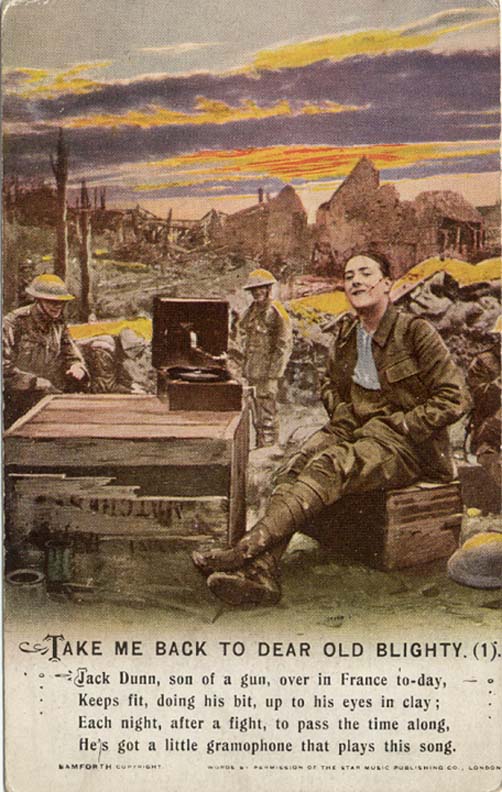
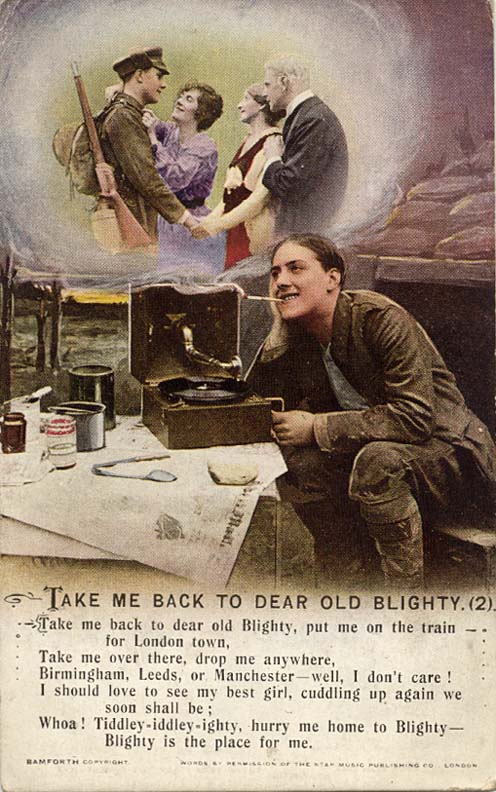
Take Me Back To Dear Old Blighty — a phrase so famous that it finds a place in the Oxford Dictionary of Modern Quotations — was a favourite of the British Tommies on the Western Front and wherever they found themselves, in both tragedy and triumph. Reporting on the torpedoing of the troopship Aragon in the Mediterranean in December 1917, in which 610 men died, a newspaper quoted one survivor as saying,
they were nearing the end of the voyage, after spending a most enjoyable Christmas aboard, when the tragic event occurred. The ship was struck about nine o’clock on the morning of December 30th. Although there was much commotion there was no panic, and the troops lined up on deck singing ‘Keep the home fires burning’ and ‘Take me back to dear old Blighty’. The vessel foundered in about 17 minutes. Owing to her list, it was impossible to lower all of the lifeboats.1
As a happier example, another newspaper reported that, soon after Armistice Day 1918, “Constantinople had the biggest thrill since the arrival of the British when this morning a battalion landed near Galata Bridge and marched up the hill to Pera, headed by a band playing the cheery melody ‘Take me back to dear old Blighty’.”2 As a morale-booster, the song had few peers, as this extract from a letter home by a sergeant from Leeds, writing in December 1916, attests:
I am in very good health, though severely tested by the wretched weather of recent days. Really it is marvellous what one can go through, and as I have looked on men coming out of the trenches covered in mud, and apparently in an awful condition, yet full of laughter and song, I have thought how do they do it? Is it the gift of the English temperament and inheritance? If so, it is a jolly good job we have it, for it is a winning strain. Tickled to death at times, muddied up to the eyes, still they sing ‘Take me back to dear old Blighty, Blighty is the place for me.’3
 Indeed, the
song’s association with the First World War is almost iconic. Noël Coward borrowed Blighty for his sprawling 1931 stage production Cavalcade, about British life in the first two decades of the twentieth century. In the Academy Award–winning 1933 film version, however, Coward dropped Blighty in favour of another Godfrey song, Take
Me Back To Yorkshire [1910], for a scene set on an Edwardian seafront. In his follow-up film This Happy
Breed (1944), directed by David Lean,
Coward favoured Blighty once again, having returning Tommies sing it as the camera pans over the London streets of 1919 from high above in the film’s opening sequence.
Indeed, the
song’s association with the First World War is almost iconic. Noël Coward borrowed Blighty for his sprawling 1931 stage production Cavalcade, about British life in the first two decades of the twentieth century. In the Academy Award–winning 1933 film version, however, Coward dropped Blighty in favour of another Godfrey song, Take
Me Back To Yorkshire [1910], for a scene set on an Edwardian seafront. In his follow-up film This Happy
Breed (1944), directed by David Lean,
Coward favoured Blighty once again, having returning Tommies sing it as the camera pans over the London streets of 1919 from high above in the film’s opening sequence.
Blighty has been used in several other films as well. It appears in a 1929 Vitaphone short called Pack Up Your Troubles, where it is sung by a group called The Lyric Quartet, and in Not So Quiet On The Western Front (1930), starring Leslie Fuller and Mona Goya. It is reprised in 1943’s Variety Jubilee, a film about the Music Halls and featuring appearances by Charles Coborn, Tom E. Finglass (as Eugene Stratton), Ella Retford, and George Robey. Blighty shows up in Love Story (1944), starring Margaret Lockwood and Stewart Granger; The Rake’s Progress (1945), starring Rex Harrison and Lilli Palmer, and in the Errol Fynn film Let’s Make Up [also known as Lilacs In The Spring] (1956). In The L-Shaped Room (1962), Australian actress Cicely Courtneidge, playing an aging Music Hall star, belts it out in army tunic and cap (Courtneidge was no stranger to Godfrey songs, by the way, having performed his My Tennessee, Is That You Calling Me? in pantomime in 1919). In the 2006 film Flyboys, World War One British airmen are heard singing it in their barracks in France.
Here’s what a 1933 newspaper article had to say about Blighty:
Think of all those songs of the war sung in ritual once a year on November 11. Who wrote them?....It is odd, this anonymity about the authorship of the songs we all sang in those war years....What do their composers think when they hear those songs of the war every Armistice Day? And do the singers ever wonder who wrote the words and music of the songs with such poignant memories?
“Take Me Back To Dear Old Blighty” [etc.] ...— who was responsible for setting millions of throats singing these songs? Blighty” was the work of three men in “Tin Pan Alley,” London: Bennett Scott, Fred Godfrey, and A.J. Mills. They were men fairly well known in that strange province of the Arts in Charing Cross Road. They wrote numbers for pantos, revues and music hall turns. But “Blighty” was their biggest hit. Now it is among the immortal songs. Little did those three friends think they were contributing to British history when they sat round the piano knocking their new number into shape.4
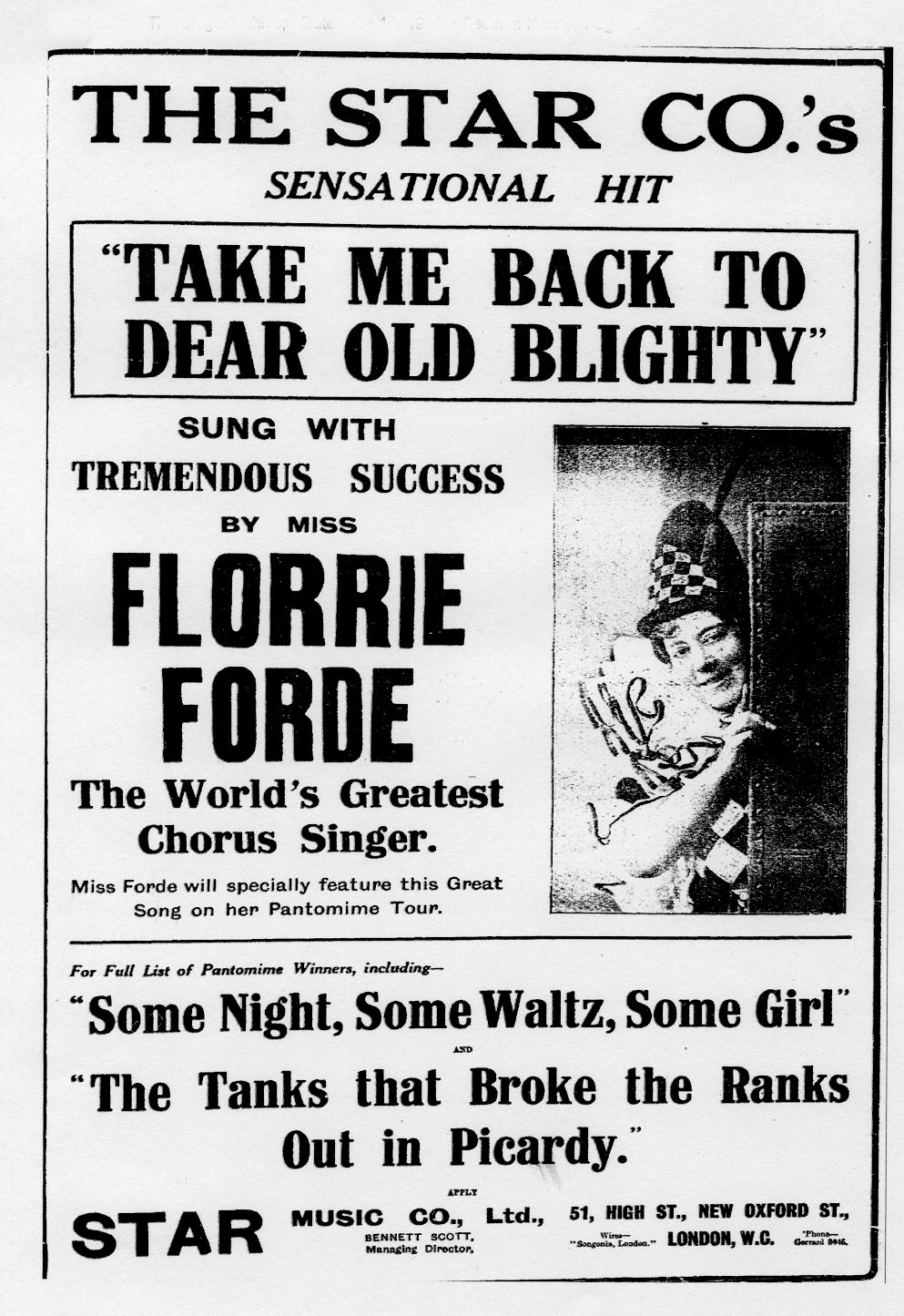
Though both Florrie Forde and Ella Retford sang the song with great success, it was effervescent Dorothy Ward, wife of Music Hall star and songwriter Shaun Glenville, who introduced it. In a newspaper article, Miss Ward reminisced: “Then [in 1916] came Take Me Back To Dear Old Blighty, which Fred Godfrey wrote in my house at Hampstead. I was due to sing it at Liverpool the next day, and there was no time to get the band parts written, so Godfrey himself came up with me and accompanied me on the piano.”5 Indeed, Godfrey sat in for a time as Dorothy Ward’s pianist on the stage (“Melodyland,” The Era, 20 September 1916, p. 14), so he evidently was quite comfortable playing in public.
In an undated interview, Godfrey had a more modest recollection of how the song came about: “At the old Oxford Music Hall there was a show called ‘Blighty.’ Bennett Scott, A.J. Mills and I were going by, and one of us suddenly said ‘What an idea for a song!’ Four hours later it was all finished, and the whole country was singing it soon afterwards. I got — not very much.”
Still another source suggests that the inspiration for the song was “Captain Bruce Bainsfather’s humourous ‘Fragments from France’,”6 a popular cartoon featuring a cast of Tommies headed by a character called Old Bill that appeared in The Bystander magazine during the war.
A trade newspaper noted:
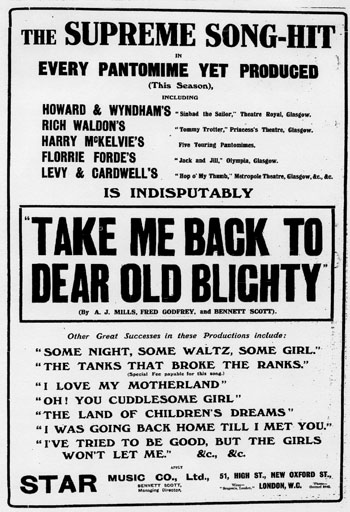
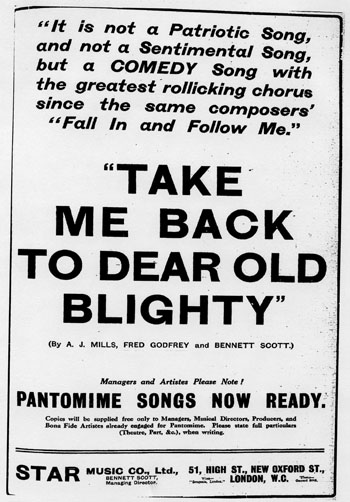
“Take Me Back To Dear Old Blighty” is the talk of Leeds this weeks, as a result of Daisy Dormer featuring the song at the local Empire. There are a good many “Blighty songs” on the market at the moment, but it is certain that not one of them conveys the spirit of optimistic abandon or gives the real Tommy touch, as is apparent in the British Tommy himself, as this one does. There is no attempt at sentiment in the number; it is purely a comedy song, with quaint, whimsical touches.7
Blighty became the greatest hit of Fred Godfrey’s early career. Years later, in 1929, he was induced to appear on the Variety stage with Irish tenor Tom E. Finglass. The act featured Godfrey’s best-known chorus songs — with Fred on piano, an ever-present fag hanging from his lip — and Blighty was their big finish. After their 11 November 1929 appearance at the Exeter Hippodrome, the local newspaper’s reviewer gushed,
The presence on stage of Fred Godfrey, the author of “Take Me Back To Dear Old Blighty,” gave rise to scenes of remarkable enthusiasm at Exeter Hippodrome last night, and the audiences at both houses revelled in the popular war-time chorus, the singing of which, however, was tinged with a feeling of sadness. Rarely, if ever, has there been a more unique occasion at the Hippodrome. Apart from the atmosphere engendered by the appearance on the stage on Armistice Night of the man who wrote a ditty that will always be associated with memories of the war, the popularity of many other songs composed by Fred Godfrey was made manifest, these including “Who Were You With Last Night?” and “Down Texas Way.”
Take Me Back To Dear Old Blighty continued to evoke home for Britons decades after the song was first heard. Just as their fathers had in the Great War, servicemen in the Second World War sang it for its yearning for home and to keep their spirits up:
[An RAF pilot, on the homeward leg of a bombing mission to Germany] The searchlights are on us again. Somehow, I do not mind nearly so much now: Why? because I am on my way home? Soon we shall be near the coast. Gun flashes on the ground: I am still weaving violently. We are crossing the coast; I am chewing my gum frantically, I dive steeply to gain speed; the coast recedes. We are comparatively safe. My rear gunner starts to sing “Take Me Back To Dear Old Blighty.”8
Out of the morning mists a white ship, marked with Red Crosses, moved slowly towards a landing-stage at a port in the West of Britain yesterday. It was a ship bringing home over 400 prisoners of war and protected personnel from Italy, a ship with a name which epitomised the feelings of the cheering and waving men who lined her decks—the Newfoundland. Across the waters came the robust singing of...“Take Me Back To Dear Old Blighty.” Long before the ship docked, the men had been leaning forward from the upper deck, straining to get a first glimpse of Britain.9
Returning servicemen and POWs from Burma and the Far East happily sang the song, too:
To the tune of ‘Take me back to dear old Blighty,’ the liner Strathmore docked at Southampton to-day with more than 4,000 men of the 14th Army, among them men of the Gloucestershire Regiment. The Gloucestershire men were those who had fought down the corridor from Myitkyina to Mandalay [in Burma] and at Kohima.10
Six hundred and fifty-four of Britain’s “Never Forgotten” men reached England yesterday with never-to-be-forgotten memories — memories of years endured in the hell of Japanese prison camps. They were the second batch of Far-Eastern prisoners to return....[and] were singing ‘Take me back to dear old Blighty’ as they filed down the gangway.11
The song remained popular with homecoming Britons long after the end of the war, too. The Dundee Courier included a “Stop Press” item on the front page of its 31 October 1946 issue announcing the arrival of the passenger liner Queen Elizabeth on its maiden civilian West-to-East Atlantic crossing: “Queen Elizabeth berthed at Southampton early this morning. She had completed her maiden West to East voyage from New York in five days and three hours. Many passengers in evening dress lined the decks as she berthed, singing ‘Take Me Back To Dear Old Blighty’.” And in 1955, air service between London and Perth, Australia began with a Godfrey sendoff: “To cheers and a brass band playing ‘Take Me Back To Dear Old Blighty,’ a Qantas Airlines Superconstellation left Perth, Western Australia, to-day on the first flight of a regular Perth-London service.”12
 |
 |
Recordings
 |
 |
 |
 |
The length of the list of known Blighty recordings attests to the song’s popularity over the 100 years since it first captured the public’s ear. One of the more unusual, and moving, versions is that of British blues singer Kevin Coyne, on his 1978 LP Dynamite Daze. Another unexpected tribute came in 1986 from the influential British rock band The Smiths, who quote a snippet of Cicely Courtnedge’s recording of Blighty at the start of The Queen Is Dead, voted 15th-best album of all time in a “Music of the Millennium” poll conducted by HMV, the BBC’s Channel 4, The Guardian newspaper, and London radio station Classic FM.
Dorothy Ward (Regal G-7398, 1916)
F.W. Ramsey (Regal G-7404, 1916)
Courtland & Jeffries (HMV B-760, 1916)
J. Norrie (Clarion 970, 1916 [cylinder]; Clarion 171, 1916)
Florrie Forde (Zonophone 1725, 1916)
———, in “Selection of Old Time Hits” (Rex 8093, 1933)
Harry Cove & Will Thompson (Coliseum 1013; Coliseum 1022)
Hay & Croft (Scala 1022)
Stanley Kirkby (The Winner 3085, 1916)
The Band Of H.M. Irish Guards, cond. by Chas. Hassell (The Winner 3113, 1916)
Arthur Fields (Columbia A-2451, 1917)
The Two Filberts (Jumbo 1501, 1917)
The Unity Quartette (Columbia 2742, 1917)
Jamieson Dodds, in “Service Songs” (Columbia 2767, 1917)
Robert Carr (Clarion 185, 1917)
Alan Turner (HMV 216020-A, 1918)
Robins & White (Scala 938, 1927?)
Community Singing, in “Song Memories Of The War” (HMV B-2637, 1927)
Community Singing, in medley (HMV C-1601 [12"], 1928)
Band of H.M. Welsh Guards, in “Popular War-Time Marching Songs” (Broadcast 365, 1928)
Band of H.M. Life Guards, in “Community Song Selection” (Broadcast 430, 1928)
The London Orchestra; dir. by John Firman, in “Communityland — Selection” (Zonophone 5313, 1929)
Charles “Nat” Star & His Band, in “Songs Of The Western Front” (Sterno 561, 1929)
Harry Davidson & His Orch., 1930s?; reissued on CD & cassette tape “Harry Davidson” (Evergreen Melodies C77 [disc], E77 [tape], 2002/03 catalogue)
Ella Retford, in “Ella Retford Songs Medley” (Regal Zonophone MR-205, 1930); reissued on LP “The Greatest Music Hall Bill Ever Assembled” (Music For Pleasure MFP-1146, ca. early 1960s); reissued on cassette “Playing The Halls 1” (Evergreen Melodies EVR9, 1991); reissued on CD “Top Of The Bill” (Pearl PAST CD 9753, 1992); reissued on 3-CD set “Great Songs From The War Years” (Big 3, 2014)
Debroy Somers Band, in “War Marching Songs” (Columbia DX-112, 1930)
Jack Hylton & His Orchestra, in “Tommies’ War Time Memories” (HMV C-1888, 1930; Victor 130815-A, 1930)
———, in “Jubilee Cavalcade” (HMV C-2744, 1935)
Imperial Vocal Medleys, in “Echoes of 1914 — Army Songs” (Imperial 2464, 1930)
The Jolly Old Fellows, in “Dug-Out Ditties” (Regal MR-193, 1930)
Will Evans & Company, in “Khaki Memories (A Song Scena)” (Edison Bell Winner 5282, 1931)
Noël Coward, in “Cavalcade Vocal Medley” (HMV C-2431, 1932)
Don Porto’s Novelty Accordion Band, in “Recollections Of 1914-1918” (Eclipse 813, 1933)
Gracie Fields, in “Old Soldiers Never Die” (Rex 8618, 1935)
Primo Scala’s Accordion Band, in “Carry On Melodies”
(Rex 9635, 1938)
Lew Stone & His Band; Sam Browne, vocal, in “Songs the Tommies Sing” (Decca F-7278, 1939)
Sidney Thompson’s Old-Tyme Dance Orchestra, in “Marine Four Step Communityland March Medley” (Parlophone R-3580, 1951)
Verdi and Jimmy Silver & His Music, on LP “Party Time At The Astor Club” (Decca LK-4290, 1958)
Cicely Courtnedge, from soundtrack of film The L-Shaped Room (1962), interpolated by The Smiths on LP “The Queen Is Dead” (Rough Trade Rough 96, 1986); and CD (Rough Trade Rough CD96, 1986)
Jimmy Shand & His Band, in medley (Parlophone R5050, 1963)
Carl Tapscott Singers, on LP “Pack Up Your Troubles” (RCA Camden CASX-2527, 1964)
Warren Mitchell, with Bill Shepherd, His Orch. & Chorus, on LP “Alf Garnett Sings Songs Of World War I” (Allegro ?, 1967?)
The Concert Band & Chorus Of The R.A.A.F., directed by Sqd. Ldr. R.A.Y. Mitchell, on LP “30 Smash Hits Of The War Years” (Crest WAR-39/45, 1974); reissued on CD disc & cassette tape “Songs Of Britain” (Evergreen Melodies C84 [disc], E84 [tape], 2002/03 catalogue)
Barry O’Dowd & The Strand Singers, on LP “English Pub Songs” (Axe AXS 516, 1976 re-issue of earlier Australian release)
Kevin Coyne, on LP “Dynamite Daze” (Virgin V2096, 1978; reissued on CD, Virgin CD12096, 1991)
Diamond Accordion Band, on LP “Your Favourite Singalongs, Vol. 2” (Emerald Gem GES-1229, 1980s)
Connor, on CD “The Magic Wurlitzer, Vol. 1” (Prism PLATCD 31, 1992)
 |
 |
Film Interpolations
Pack Up Your Troubles (1929); Not So Quiet On The Western Front (1930); Variety Jubilee (1943); This Happy Breed (1944); Love Story (1944); The Rake’s Progress (1945); Let’s Make Up [also known as Lilacs In The Spring] (1956); The L-Shaped Room (1962); Flyboys (2006). The song was also interpolated in the “screen comedy” The Better ’Ole, starring Syd Chaplin and Bruce Bairnsfather (La Scala Theatre, Coventry, December 1927), but on the assumption this is a silent film, perhaps flash cards are merely used to indicate its being sung..
Stage Interpolations
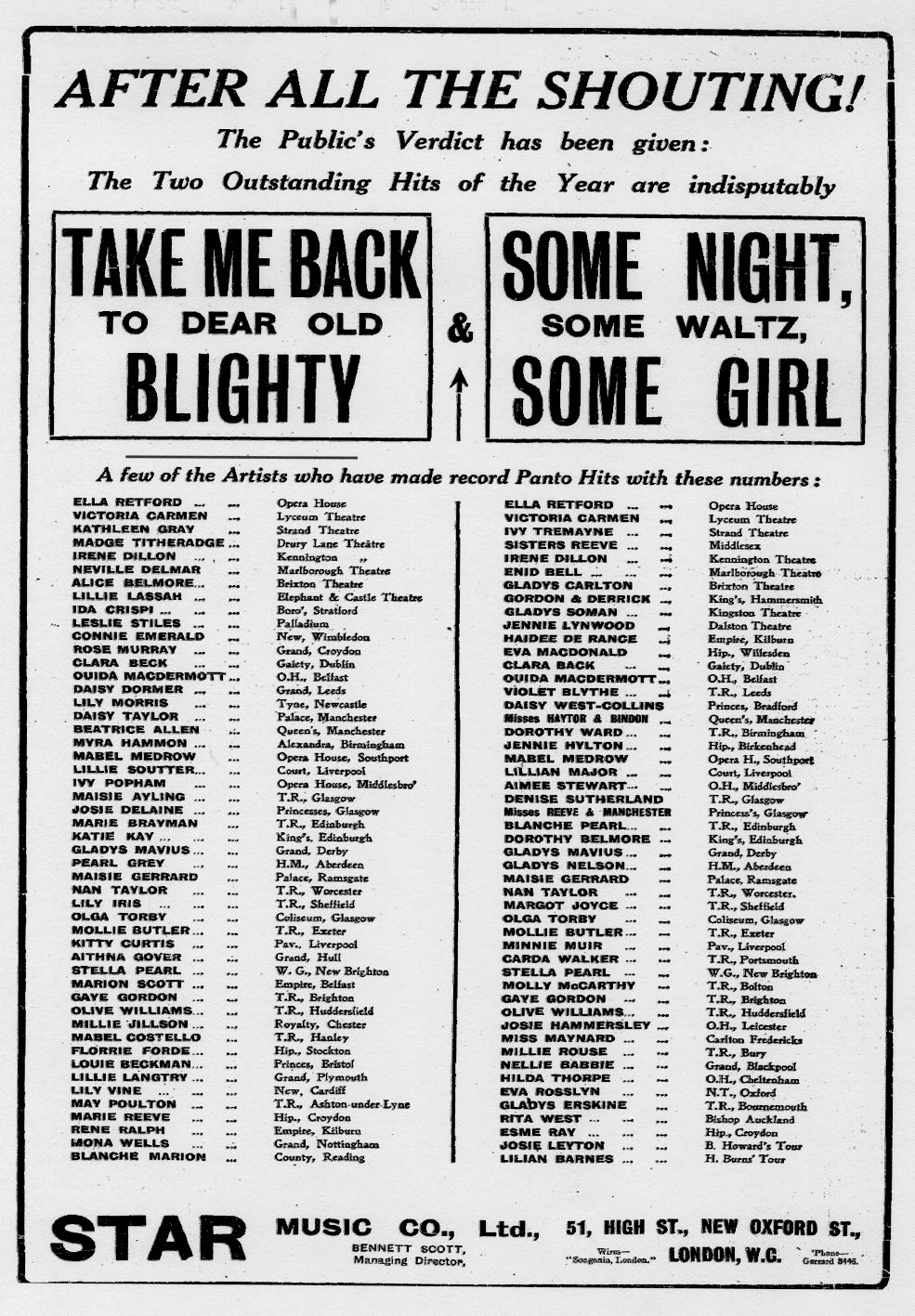
Numerous pantomime productions, including Howard & Wyndham’s Sinbad The Sailor (Theatre Royal, Glasgow, 1916); Rich Waldon’s Tommy Trotter (Princess’s Theatre, Glasgow, 1916); Florrie Forde’s Jack And Jill (Olympia, Glasgow, 1916); Levy & Cardwell’s Hop O’ My Thumb (Metropole Theatre, Glasgow, 1916); by Lily Vine in Dick Whittington (New Theatre, Cardiff, December 1916); by Olga Torby in Little Bo Peep (Regent, Salford, December 1916); in Noël Coward’s Cavalcade (opened 13 October 1931, Theatre Royal, Drury Lane, London, 405 performances).
__________________
Notes
1 “The Aragon: Last scene on torpedoed troopship — every man for himself,” Western Gazette, 15 February 1918, p. 1.
2 “British in Turkey: Battalion of our men landed at Constantinople,” Birmingham Gazette, 25 November 1918, p. 3.
3 “Gossip of the day: The winning strain,” Yorkshire Evening Post, 22 December 1916, p. 4.
4 “War songs and their writers,” Sunday Times (Perth, Australia), 15 October 1933, p. 11; reprinted from the London Sunday Times.
5 Dorothy Ward, “Live, love and laugh,” Daily Sketch (London), 10 May 1932, p. 10.
6 “A favourite song,” Sheffield Weekly Telegraph, 19 May 1917, p. 10.
7 “Melodyland,” The Era, 1 November 1916, p. 14.
8 “Operation successfully completed, Sir,” Daily Mirror, 31 August 1942, p. 4.
9 “Repatriated prisoners,” Scotsman, 24 April 1943. The newspaper also reported, for good measure, that the soldiers had been heard
singing Godfrey’s Bless ’Em All “with great gusto.”
10 “Burma leave men home,” Gloucestershire Echo, 15 November 1945, p. 1.
11 “‘Blighty’ again: Jap horrors behind them,” Western Morning News, 9 October 1945, p. 2.
12 “Perth-London air service has started,” Coventry Evening Telegraph, 11 August 1955, p. 22.
Please click here to return to the Home Page.