George Formby Jr. (1904–61)
-s.jpg) |
(Mander
and Mitchenson Theatre Collection, with permission) |
One of the most popular entertainers in Britain during the 1930s and ’40s, and for several years Britain’s biggest box office film star, George Formby Jr. was the son of the great tubercular Music Hall artiste of the same name. The life and career of Wigan-born Formby have been exhaustively researched,1 and there has recently been a great outpouring of CD and DVD reissues of his recordings and films. For those who are unfamiliar with “The Lad from Wigan,” a great place to start is the website of the George Formby Society: http://www.georgeformby.co.uk.
The first Fred Godfrey song that Formby recorded was A Lad From Lancashire, in October 1939 (Regal Zonophone MR-3206). Formby went on to record the following additional Godfrey songs:
The Lancashire Romeo (Regal Zonophone MR-3233, 1939)
Bless ’Em All (Regal Zonophone MR-3394, 1940)
Bless ’Em All No. 2 (Regal Zonophone MR-3441, 1941)
(for other Formby recordings of this song, see under the song title)
Homeguard Blues (Regal Zonophone MR-3689, 1942)
Oh! You Have No Idea (Regal Zonophone MR-3694, 1942)
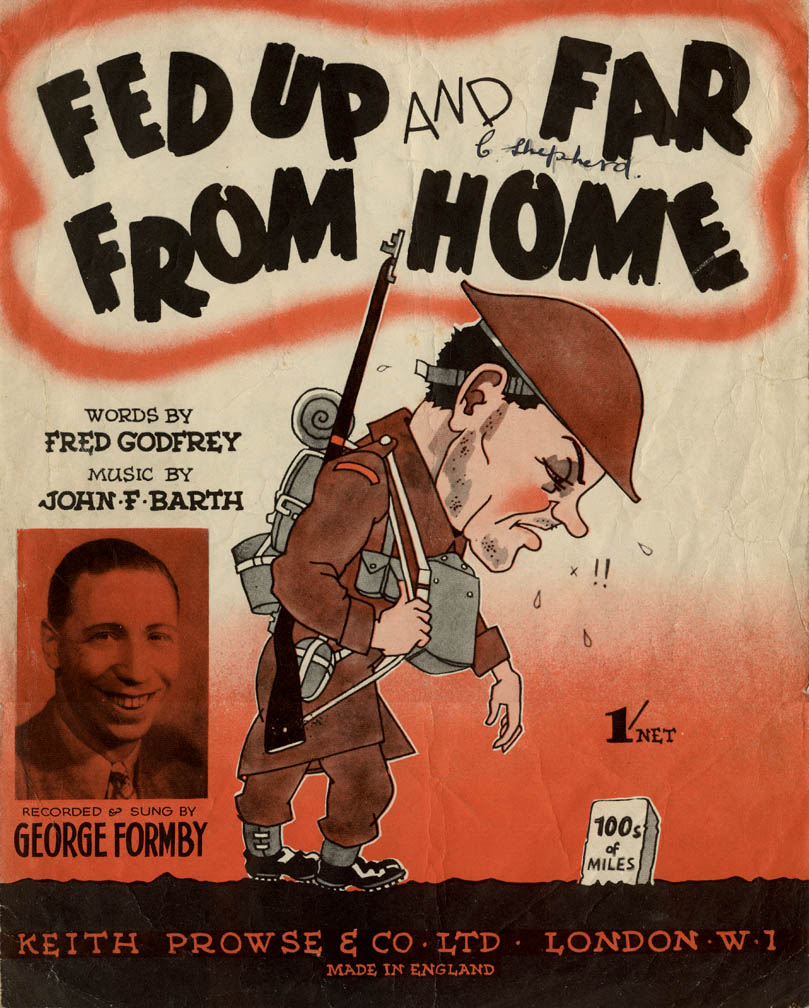
Despite the advertising on the sheet music cover, George Formby never recorded this song, according to discographer Brendan Ryan. |
Listen
to George Formby singing |

Out In The Middle East (Regal Zonophone MR-3624, 1942)
You Can’t Love Two Girls At The Same Time (Regal Zonophone MR-3663, 1942)
Godfrey penned several other songs for Formby, who may have performed them on stage or on the radio, but did not record them: Keep Your Flashlight In Your Hand (with Amy Parsons, 1939); Fed Up And Far From Home (1941); Let’s Have A Little Bit Of Peace (1944); The Little Back Room Upstairs (1944); Mister Wu (Is In The Chinese Navy Now) (1944); Only A Poor Little Private (1944); Rolling Into France (1944), written for George’s ENSA tour of France, August 1944; We Haven’t Quite Decided Yet (1944); Hello Canada! (1947, written for Formby’s tour of that country); and On The Other Side Of The World (1947, written for Formby’s tour of Australia and New Zealand). Of uncertain date are: Those Were The Days (1944?); and Things Were Different Years And Years Ago (late 1940s?).
About the 1947 tour of Australasia, a Sydney newspaper reported:
The world-famous Lancashire comedian, George Formby, arrived in Sydney from New Zealand yesterday accompanied by his wife (or, as he called her, “his old woman”), a pianist, five instruments which he said were banjuleles, an appetite for Australian horse-racing, and the manuscript for a song called “On The Other Side Of The World,” which was specially written for his Australian tour by the composer of “Blighty,” Fred Godfrey.2
During the tour, Beryl Formby, George’s wife, was quoted as saying “We buy the entire song output of a man named Fred Godfrey. Some are good, some not so good, but the good ones makes up for the ones that can’t be used.”3
__________________
Notes
1 For a useful summary
of Formby’s life and career, see Peter Gammond, The Oxford Companion to Popular Music (Oxford: Oxford
University Press, 1991), p. 203. For a fuller account, see Alan Randall and Ray Seaton, George Formby: A Biography (London: W.H.
Allen). For diehards, there is Brendan Ryan, George Formby, A Catalogue of His Work (Dublin: The George Formby Society, [1986]),
though even Ryan does not list the many songs Formby sang on radio and in concerts but never officially recorded, among them several
Godfrey songs, as noted.
2 “Crowds wait in street for Formby,” Sydney Morning Herald, 27 September 1947, p. 3.
3 Esme Johnston,“‘Marriage is real fun’ say George and Beryl Formby,” Melbourne Weekly Times, 31 December 1947, p. 27.